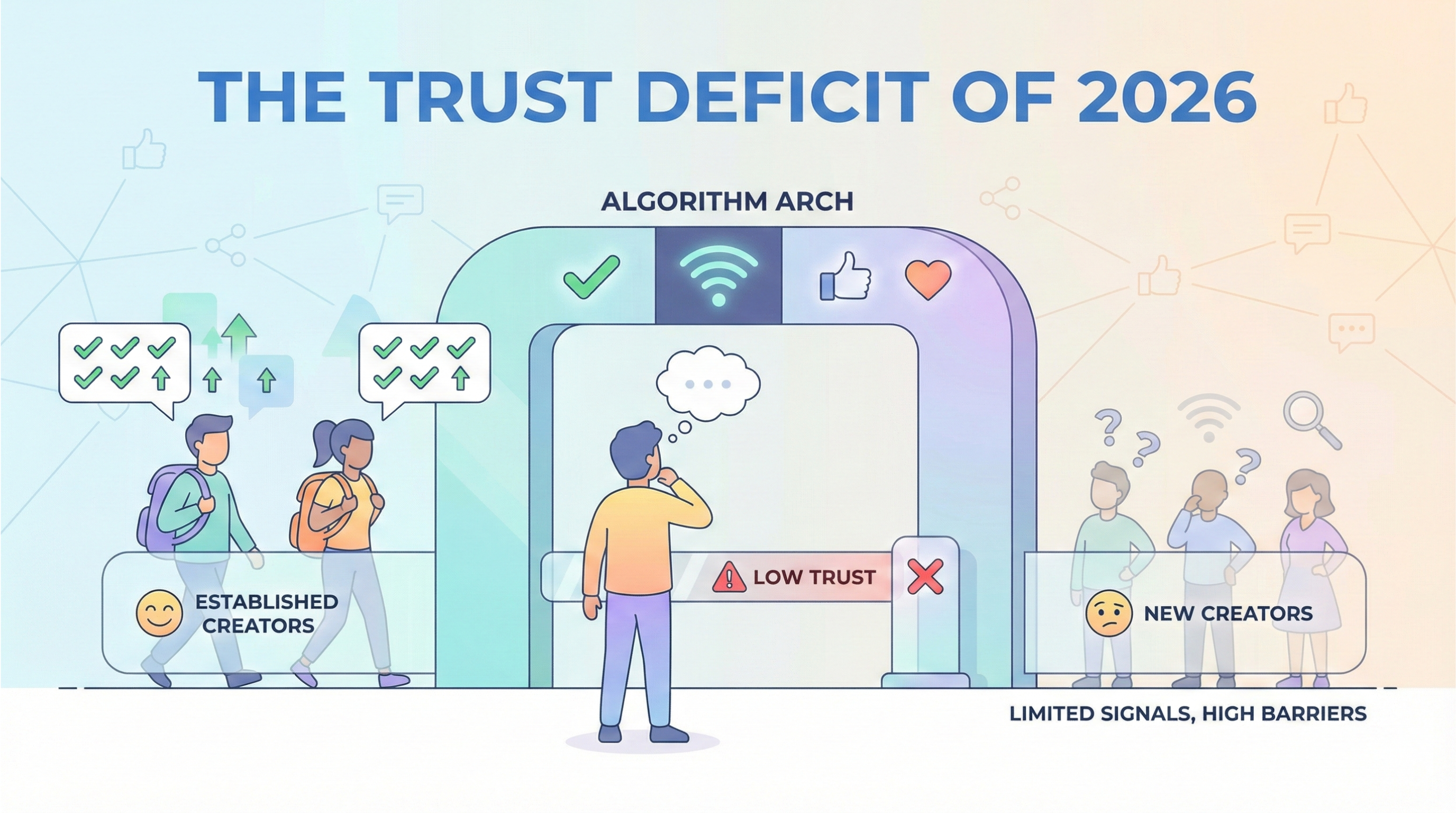
The Trust Deficit of 2026: Why Algorithms Don’t Believe New Creators Anymore
If you’re a new creator in 2026, you’ve probably felt this frustration already.
You post consistently.
Your content is decent.
You follow trends.
You optimize captions.
Yet your reach is painfully low. Posts barely move. Views stall. Engagement feels nonexistent.
Meanwhile, older accounts post average content and still get pushed.
This isn’t about talent.
It isn’t about effort.
And it’s definitely not about luck.
It’s about trust.
In 2026, social media platforms don’t just rank content — they judge creators. And new creators are starting at a disadvantage most people don’t realize exists.
This is the trust deficit, and it’s quietly controlling who grows and who stays invisible.
What the “Trust Deficit” Actually Means
The trust deficit is the gap between what a creator does and what the algorithm believes about them.
In simple terms:
The algorithm does not trust new or low-authority accounts to keep users engaged.
So it limits their reach by default.
Platforms don’t assume your content is valuable.
They assume the opposite — until proven otherwise.
That’s a massive shift from earlier years, when new creators were often boosted to encourage growth.
Why Platforms Became Distrustful in 2026
This change didn’t happen randomly. It was forced.
1. AI Content Flooded Every Platform
In 2026, platforms are overwhelmed with:
- AI-generated videos
- auto-posting accounts
- recycled clips
- low-effort spam content
Algorithms needed a way to separate real creators from noise.
So they started relying heavily on trust signals.
2. Too Many New Accounts, Too Little Attention
Millions of new accounts are created every month.
If platforms pushed every new creator equally, feeds would be chaos.
Trust filters became necessary to control distribution.
3. Platforms Prioritize Retention, Not Fairness
Algorithms don’t care about fairness.
They care about:
- watch time
- session length
- user retention
- ad exposure
If an account hasn’t proven it can hold attention, it won’t get reach.
How Algorithms “Judge” New Creators
Algorithms don’t think like humans.
They don’t care about potential.
They care about patterns.
Here’s what they silently analyze:
- Do people interact quickly with this account’s posts?
- Does engagement happen naturally?
- Are viewers staying or scrolling away?
- Does this account trigger conversations?
- Does it look trusted by other users?
If the answers are weak, the account is restricted — quietly.
No warning.
No notification.
Just low reach.
Why New Creators Feel Invisible
This is why new creators often experience:
- posts stuck at 0–50 views
- no discoverability
- content not reaching followers
- inconsistent performance
- feeling “shadowbanned”
In reality, it’s not a shadowban.
It’s low trust.
The algorithm is waiting for proof.
Why “Just Keep Posting” Is Bad Advice in 2026
This advice worked years ago. It doesn’t anymore.
Posting repeatedly without traction actually reinforces low trust signals.
From the algorithm’s perspective:
“This account posts often, but nobody reacts. Maybe it’s not worth pushing.”
That’s how creators dig deeper into the trust deficit without realizing it.
How Creators Can Rebuild Algorithm Trust
Trust isn’t built by volume.
It’s built by signals.
Here’s what actually works in 2026:
1. Early Engagement Is the Strongest Trust Signal
The algorithm watches your post immediately.
If nothing happens early, trust decreases.
If engagement appears early, trust increases.
This is why many creators now rely on small, realistic engagement boosts to help break the initial silence — especially when starting out.
Tools like BulkCheapService.com are used not to fake popularity, but to:
- show early activity
- create momentum
- make interaction feel normal
- help the algorithm “believe” the account
Trust starts with movement.
2. Social Proof Changes Viewer Behavior
People engage where others already have.
A post with zero interaction feels risky to react to.
A post with some activity feels safe.
This psychological effect directly influences algorithm trust.
3. Consistency Matters More Than Frequency
Posting every day doesn’t build trust if nothing happens.
Posting consistently with engagement does.
Quality signals beat quantity signals in 2026.
4. Interaction Builds Trust Faster Than Views
Likes, comments, and saves matter far more than raw views.
A small engaged audience is more powerful than a large silent one.
Why BulkCheapService.com Fits This Problem Naturally
New creators don’t lack creativity.
They lack initial trust signals.
BulkCheapService.com helps bridge that gap by:
- supporting early engagement
- preventing posts from dying silently
- helping new accounts build credibility
- accelerating trust signals the algorithm looks for
In 2026, trust must be demonstrated — not assumed.
The Hard Truth About Growth in 2026
Growth is no longer democratic.
Algorithms don’t give new creators a chance just because they exist.
They require proof.
If you understand this, you can work with the system.
If you don’t, you’ll keep posting into silence.
Final Thoughts
The biggest mistake new creators make is assuming the algorithm is neutral.
It’s not.
It’s cautious.
It’s skeptical.
And it doesn’t believe in you — until you give it reasons to.
Once you focus on building trust instead of just posting content, growth becomes possible again.
FAQ
Why do new creators struggle more than old ones?
Because older accounts already have trust and engagement history.
Is the trust deficit permanent?
No. It can be reversed with consistent engagement signals.
Do views help build trust?
Only if they come with interaction.
Can early engagement really change algorithm behavior?
Yes. Early signals strongly influence distribution decisions.
Is using engagement tools risky?
When used realistically and strategically, they support natural growth patterns.
Will this problem get worse in 2027?
Most likely. Trust-based ranking systems are increasing, not decreasing.