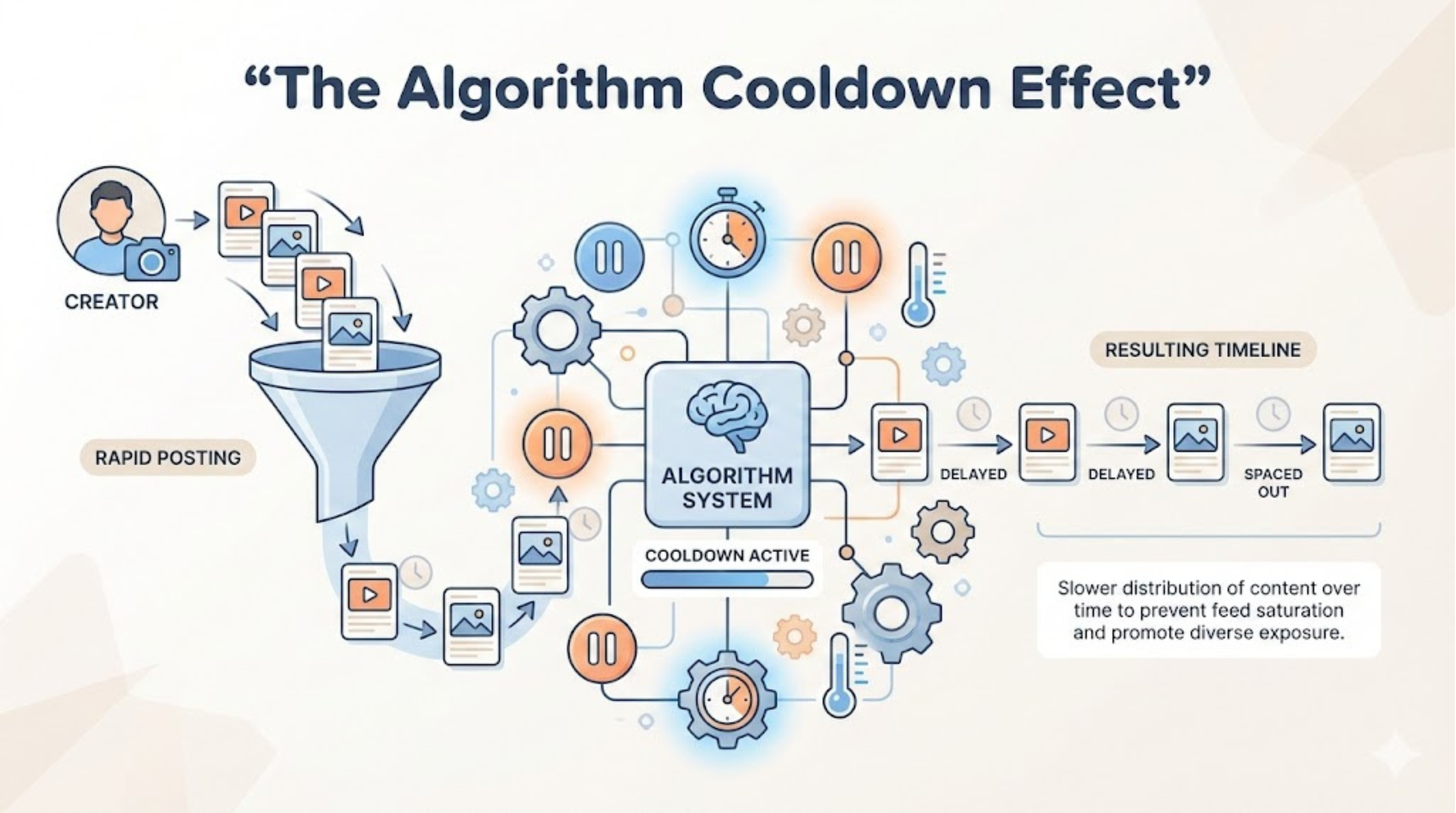
The Algorithm Cooldown Effect: Why Posting Too Often Hurts Reach in 2026
For years, creators were told one thing:
“Post more. Stay consistent. Upload every day.”
In 2026, that advice is quietly destroying accounts.
Creators are posting more than ever — and reaching fewer people than ever. Views drop suddenly. Engagement feels capped. Some posts don’t even get tested properly.
It feels random.
It feels unfair.
But it’s not a bug.
It’s something most creators don’t know exists:
The Algorithm Cooldown Effect.
What Is the Algorithm Cooldown Effect?
The algorithm cooldown effect happens when platforms temporarily reduce your reach because you’re posting too frequently without strong engagement signals.
In simple terms:
- You post again before the algorithm finishes evaluating your last post
- Your content competes with your own content
- The system slows distribution to protect user experience
Instead of helping you grow, overposting tells the algorithm:
“This account floods content but doesn’t create strong reactions.”
So reach gets throttled — silently.
Why Platforms Introduced Cooldowns in 2026
This didn’t exist years ago. It exists now for a reason.
1. AI Content Changed Everything
AI tools allow creators (and bots) to post endlessly.
If platforms didn’t add cooldown logic:
- feeds would be spammed
- users would burn out
- retention would drop
Cooldowns protect the platform, not the creator.
2. Platforms Care About Retention, Not Output
Algorithms don’t reward effort.
They reward viewer satisfaction.
If posting more doesn’t increase engagement, it actually hurts performance.
3. Overposting Signals Low Confidence
To an algorithm, rapid posting with weak engagement looks like:
- guessing
- testing randomly
- chasing visibility
- low content confidence
That lowers trust.
Signs You’re in an Algorithm Cooldown
Most creators don’t realize what’s happening. They just feel “stuck.”
Here are clear signs:
- New posts get fewer views than older ones
- Reach drops suddenly without explanation
- Engagement doesn’t scale with frequency
- Posts stop hitting Explore / For You
- Views plateau at the same number repeatedly
- Posting more makes things worse, not better
This isn’t a shadowban.
It’s the system slowing you down.
Why “Posting Daily” Is Bad Advice in 2026
Daily posting only works if:
- your engagement is strong
- retention is high
- each post earns attention
If those conditions aren’t met, daily posting trains the algorithm to expect low performance.
In 2026:
Quality signals > quantity signals.
One strong post outperforms five weak ones.
How Cooldowns Actually Work (Behind the Scenes)
Algorithms now evaluate:
- how your last post performed
- whether viewers reacted or ignored it
- how fast engagement arrived
- whether your audience feels fatigued
If you post again before enough signals are collected, the system limits exposure to avoid feed overload.
Think of it like this:
The algorithm needs time to “digest” your content.
If you keep feeding it nonstop, it slows you down.
Why This Hurts New and Small Creators the Most
Big creators already have:
- loyal audiences
- built-in engagement
- high authority scores
Small creators don’t.
So when small accounts overpost:
- posts cannibalize each other
- engagement spreads thin
- authority drops faster
This creates the illusion that posting more should help — when it’s doing the opposite.
How Smart Creators Avoid the Cooldown Effect
Creators who still grow in 2026 don’t post more.
They post smarter.
Here’s what they do instead:
1. Let Posts Breathe
They give each post time to:
- gather engagement
- be tested properly
- reach multiple audience layers
Rushing kills momentum.
2. Focus on Early Engagement, Not Frequency
Early engagement tells the algorithm:
“This post deserves distribution.”
That matters more than how often you post.
This is why creators often use small early engagement support to ensure posts don’t stall immediately.
Platforms like BulkCheapService.com are used here strategically — not to inflate numbers, but to help posts pass the early test window so the algorithm doesn’t suppress them or trigger cooldown logic.
3. Track Performance, Not Schedules
They don’t post because “it’s time.”
They post because:
- the last post stabilized
- engagement peaked
- audience response settled
Data > routine.
4. Reduce Noise, Increase Impact
Instead of posting 7 average videos a week, they post 2–3 strong ones with:
- better hooks
- clearer emotion
- stronger calls to action
Less content, more reaction.
Why BulkCheapService.com Fits This Strategy Naturally
Cooldowns happen when platforms see low impact per post.
BulkCheapService.com helps creators:
- avoid dead launches
- increase early engagement velocity
- prevent posts from being ignored
- send stronger quality signals
- reduce the risk of cooldown throttling
It’s not about posting more.
It’s about making each post count.
The Hard Truth About Growth in 2026
Posting nonstop doesn’t show commitment anymore.
It shows inefficiency.
Algorithms want:
- strong reactions
- satisfied viewers
- controlled content flow
Creators who respect that grow.
Creators who ignore it burn out — and get buried.
Final Thoughts
If your reach dropped after posting more, you didn’t mess up.
You just followed outdated advice.
In 2026, growth comes from timing, impact, and momentum — not volume.
Slow down.
Post with intention.
Let engagement build.
And stop fighting the algorithm by flooding it.
FAQ
Does posting too often really hurt reach?
Yes, especially if engagement is weak or inconsistent.
How often should I post in 2026?
There’s no universal number. Let engagement and performance decide.
Can cooldowns be reversed?
Yes. Reduce frequency, improve engagement, and let posts stabilize.
Is this why my views suddenly dropped?
Very likely, especially if you increased posting frequency recently.
Does early engagement help avoid cooldowns?
Yes. Strong early signals reduce suppression and throttling.
Will this get stricter in the future?
Almost certainly. Platforms are prioritizing feed quality over creator volume.